

Businesses along the I-44 corridor in Central Missouri, from small shops to larger industrial sites, all face a version of the same question: how do you keep a commercial property secure without turning it into a fortress that scares off customers? The right perimeter fencing strikes that balance, and the right approach depends heavily on what you’re protecting, who needs access, and how the property is used day to day. As a family-owned fencing and welding company, we’ve worked on commercial and industrial security projects throughout the Rolla, Sullivan, and Union area, and this guide walks through how to think about securing a commercial property the right way.
None of this replaces a proper on-site security assessment, but it should give you a solid starting point before you start requesting quotes. We see the same underlying question come up across very different businesses, from a small retail lot to a larger commercial or agricultural operation, and the framework for answering it is largely the same.
Start With What You’re Actually Protecting
Before choosing a fence type or height, it helps to define the actual risk. A retail storefront with a small back lot has different needs than a distribution yard storing equipment and inventory overnight, or an industrial site with hazardous materials that require restricted access under regulation. Ask yourself:
- Is the goal deterring casual trespassing, or stopping determined theft attempts?
- Does the property need to restrict access entirely after hours, or just discourage wandering during business hours?
- Are there insurance or liability requirements driving the decision, separate from theft concerns?
- Does the site store anything that creates a legal obligation to restrict access, such as fuel, chemicals, or heavy equipment?
- Is visibility from the road part of your brand, or would a more enclosed, private perimeter actually serve the business better?
It’s also worth thinking about how the property might change over the next few years. A distribution yard that’s adding a second building, or a retail lot that’s planning to expand parking, may want a fencing plan that accounts for that growth now rather than adding piecemeal sections later that don’t quite match in height or material.
The answers to these questions typically point toward a fence height, material, and gate setup, and they also determine how much of the property actually needs to be fenced versus which areas can stay open. A business that only needs to secure a rear storage area overnight has a very different scope than one that needs to control access to the entire lot around the clock, and pricing scales accordingly.
Choosing the Right Fence Height and Material

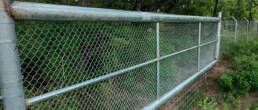
For most commercial and light industrial applications, we work with a few common approaches. Taller chain link, often in the 6 to 8 foot range, remains one of the most cost-effective ways to secure a large perimeter, especially when combined with barbed wire or privacy slats where a higher deterrent is needed. It’s fast to install across long distances, which matters when you’re fencing a full commercial lot rather than a small yard.
For sites where appearance matters as much as security, such as a business frontage visible from the highway, ornamental steel fencing gives you a more polished look while still providing a real barrier. We build our commercial fencing with all-steel bracing rather than wood supports, which holds up better to the wear a busy commercial gate sees over years of daily use, and it’s backed by our lifetime craftsmanship warranty. Many businesses along the corridor end up mixing materials across the property: taller chain link along less visible sides for cost efficiency, and steel fencing or a decorative gate at the entrance customers actually see. That combination often delivers the best balance of security and curb appeal without paying premium material costs across the entire perimeter.
Our full security and perimeter fencing services cover both approaches depending on what the property calls for, and we’re happy to walk through the cost and durability tradeoffs between the two during an on-site visit rather than trying to settle it over the phone.
Businesses that store equipment or materials outdoors, similar to the setup we build for agricultural hoop barn storage, often benefit from combining a secure perimeter fence with a covered structure, so the fence handles access control while the structure handles weather protection. It’s worth considering together rather than treating fencing and storage as two completely separate projects.
Fence height matters more than most business owners initially assume. A 4 foot fence mostly signals a boundary and won’t stop someone determined to cross it, while 6 to 8 foot fencing creates a real physical barrier that takes time and effort to get over, which is often enough on its own to discourage casual theft attempts. Adding barbed wire or privacy slats to the top of a taller fence increases that deterrent further, though it also changes the visual impression the property gives off, which matters more for a customer-facing business than a back-lot industrial site.
Gates and Access Control
A fence is only as secure as its weakest gate, and access control is often where commercial security projects need the most thought. Options range from simple manual gates with a padlock, to keypad entry, to fully automated gates that open with a remote, keycard, or connected access system tied into a business’s existing security setup.
For properties with regular delivery traffic, a wider drive gate with automation saves real time over a manual gate that someone has to get out and open every time a truck arrives. For sites with lower traffic but higher security needs, a narrower, more restricted access point with a keypad or intercom often makes more sense than a wide-open drive gate. Multiple access points also deserve a second look during planning, since every additional gate is another spot that needs to be secured and maintained, and consolidating down to fewer, well-controlled entry points is often more secure in practice than several convenient ones. If your property already has an entryway or gate that isn’t automated, adding automation to an existing gate is often more affordable than starting from scratch, since the fabrication and structural work is already in place.
It’s also worth thinking through what happens during a power outage or equipment failure with an automated gate, since a business that relies entirely on remote access needs a manual override or backup plan for the rare times the system doesn’t respond. A good commercial gate setup accounts for that edge case up front rather than leaving a business locked out or locked in during an outage.
Don’t Overlook the Rest of the Perimeter
It’s common for a commercial property to have one obviously vulnerable side, usually facing a road or a shared lot, while other sides get less attention because they back up to a field, tree line, or another business. That uneven attention is exactly what creates gaps. A full perimeter assessment should look at every side of the property, not just the most visible one, since a determined trespasser or thief will look for the path of least resistance rather than walking up to the front gate.
This is also where fencing overlaps with practical maintenance. A section of fence tucked behind a building that nobody checks regularly is a section that can develop a gap, a leaning post, or a cut section without anyone noticing for weeks. Building a perimeter that’s realistic to inspect and maintain is just as important as building one that looks secure on day one.
Tree lines and fence lines deserve a specific mention here. A fence that backs up to trees or heavy brush can look secure while actually offering easy cover for someone approaching the property unseen, and overgrowth can also push against a fence over time and weaken posts. Keeping a clear buffer along the fence line, even a narrow one, makes it easier to spot problems early and removes an easy approach route.
Security Fencing for Businesses Along the I-44 Corridor
We work with commercial and industrial clients throughout the region, including businesses in Sullivan, Union, and Cuba and St. James, and properties along the broader I-44 corridor connecting those towns. Commercial security needs in this area tend to cluster around a few common property types: light industrial sites, storage and distribution yards, and retail or service businesses with a rear lot that needs securing without blocking customer access to the front.
Because commercial projects often involve permitting, utility considerations, and coordination around business hours, we typically recommend starting the conversation early, well before you need the fence finished, rather than waiting until a security incident forces the timeline. We’ve also found that businesses expanding or relocating along the corridor benefit from planning fencing at the same time as other site work, since coordinating trenching, grading, and fence post placement in one pass is more efficient than revisiting the site later.
Quick Checklist Before You Request a Quote
Before reaching out for a commercial fencing estimate, it helps to have a rough answer to each of these:
- What’s the primary threat or concern: trespassing, theft, liability, or a combination?
- Which sides of the property need full security fencing, and which can stay lower-priority?
- How many access points does the property need, and how much traffic comes through each one?
- Is automation worth the added cost for your traffic volume, or is a manual gate sufficient?
- Are there any regulatory or insurance requirements driving specific height or material choices?
Having rough answers to these questions before your estimate helps us move faster and gives you a more accurate quote on the first visit instead of a rough range that changes once we’re on site. It also helps to know roughly where your property lines fall and whether any recent surveys exist, since that speeds up the site visit and avoids surprises once fence posts start going in.
Request an Appointment for a Commercial Security Assessment
If you’re evaluating security fencing for a commercial or industrial property along the I-44 corridor, we’re glad to walk the site with you and talk through what actually makes sense for your risk level and budget. We build every commercial fence with the same all-steel bracing and craftsmanship warranty we use on our agricultural projects, so you’re not choosing between security and durability. Whether you’re securing a single storage yard or planning fencing across a larger commercial expansion, we’ll walk the full property with you rather than just quoting the section that’s visible from the road. Request an Appointment today and we’ll schedule a time to assess your property and provide a free estimate.
Ready to Start Your Fencing Project?
At Holliday Fencing Services, we provide honest advice, quality craftsmanship, and reliable service — whether you need residential privacy fencing, commercial agricultural solutions, security perimeter fencing, or anything in between.
Contact us today for a free, no-obligation estimate.
Like this article? Spread the word!
Related Posts

Holliday Welding & Fence’s Guide to Choosing a Residential Fence Material in Central Missouri
Not sure which fence material fits your Central Missouri home? Compare chain link, wood,…

How to Choose the Right Fence for Cattle, Horses, or Mixed Livestock
Choosing a fence for cattle, horses, or mixed livestock? See what to consider, then…

Holliday Welding & Fence’s Guide to Fencing for Cattle and Horse Properties in Central Missouri
Planning fencing for a cattle and horse property in Central Missouri? Request an…